
Food giants pause shift to natural colors: What conditions are needed to drive change?
Between 2015 and 2016, food giants such as Mars, General Mills, and Kellogg's pledged to remove artificial colors from their products, but most did not meet their deadlines. Consumer acceptance of products with natural colors, technical challenges, and cost issues have become major obstacles. Meanwhile, a California study suggesting that artificial colors may affect children's behavior could spark new regulatory discussions.
On February 5, 2016, Mars, Incorporated made a major commitment: to remove artificial colors from its entire human food portfolio within five years. President and CEO Grant F. Reid said in a press release: "Eliminating all artificial colors from our human food portfolio is a significant undertaking that will take time and effort to complete. Our consumers are our boss, and we listen to them. If this is the right thing for them, then it is the right thing for Mars." Mars, which owns brands such as Skittles, Starburst, and M&M's, was not the only company to make such a commitment.
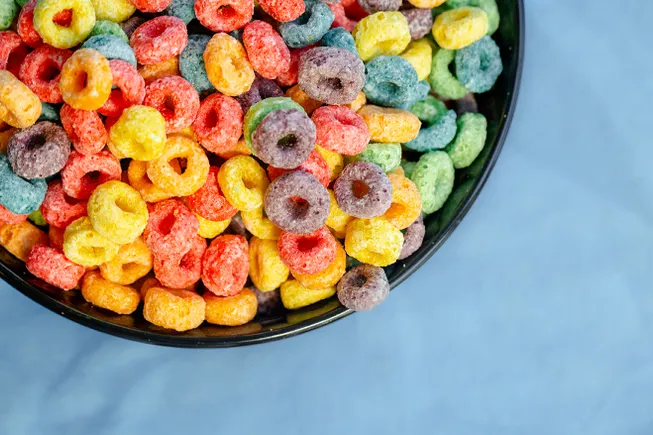
In June 2015, General Mills committed to removing artificial colors and flavors from all its cereals, including brightly colored Trix and Lucky Charms with colorful marshmallows. According to a company blog post, the goal was for 90% of its cereals to be free of artificial ingredients by the end of 2016. Kellogg's also made a similar commitment, with then-North American President Paul Norman stating during an investor call in August 2015 that the company was working to remove all artificial colors and flavors from its cereals and other products by 2019, including Froot Loops and Apple Jacks.
At the time, these decisions aligned with global consumer trends. A Nielsen report from January 2015 showed that 42% of global consumers considered it very important that products contain no artificial colors, but only 29% in North America felt the same way. However, these commitments were not fulfilled. The deadlines set by the companies passed, and the most colorful products in their portfolios still use synthetic food dyes.
The reasons for abandoning the commitments vary, but the themes are similar: companies said they believed consumers did not want artificial colors, but subsequent research proved otherwise; natural colors did not perform as well as artificial ones; and consumers were unwilling to buy natural-color products that looked duller. However, consumer advocates argue that people do indeed want to reduce artificial colors in their food. Lisa Lefferts, senior scientist at the Center for Science in the Public Interest, said: "This is deeply disappointing. I think if they had wanted to fulfill their commitments, they could have."
Since 2008, CSPI has advocated for a ban on artificial colors, when the organization formally petitioned the FDA, citing that synthetic food dyes have been linked to behavioral problems in children since the 1970s. In 2011, the FDA's Food Advisory Committee met to discuss the issue but took no action, only calling for more research. In 2016, Lefferts wrote a related report. The federal government did not act, but California legislators took up the matter. A bill proposed in 2017 requiring labeling of products containing artificial colors eventually became a comprehensive research grant of nearly $500,000, and the study was released in April.
Not all consumers want the same thing
Most companies that made commitments let the deadlines pass quietly, with only Mars updating its commitment on its website. All companies said they still have some products containing artificial colors. Kellogg's came closest to its goal, with 90% of its cereals using only natural colors; General Mills uses natural colors and flavors in over 85% of its cereals; Mars has removed artificial colors from all its dinner foods but has not prioritized transitioning North American candies to natural colors.
In a statement, Mars said that after its 2016 commitment, the company invested significant time and money in developing new ingredients, seeking regulatory approvals, improving manufacturing, and researching consumer needs. The statement said: "We found that consumer expectations for food colors vary by market and category. This prompted us to reassess our global goals and seek solutions that better fit local circumstances." In Europe, where consumers are more concerned about artificial colors, Mars is focusing on removing all synthetic dyes and emphasizes that there are many candy options globally without artificial dyes.
General Mills' transition to natural colors did not go smoothly. In early 2016, the company changed packaging for seven cereals, including Trix, emphasizing that they no longer contained artificial colors or flavors. Consumer response was positive at the time, with then-CEO Ken Powell noting in a March 2016 earnings call that sales for those brands increased by 6%. But in 2017, due to consumer complaints and declining sales, General Mills restored artificial colors in Trix. Company spokesperson Mike Siemienas told the Wall Street Journal at the time that consumers "don't all want the same thing." He also mentioned that attempts to use natural colors in Lucky Charms failed after extensive testing: "In consumer testing, consumers did not like any of the options, so we made no changes. We have exhausted the natural color sources currently available to us."
General Mills no longer treats removing artificial colors as a single R&D goal. Siemienas said the company focuses on meeting consumer needs, but those needs vary. The company will continue to innovate and update recipes as it improves products. He noted that cereals like Cheerios, Chex, and Kix are already free of artificial colors, and it has launched products for children such as Sesame Street Cereal. He emphasized: "Not all consumers want the same thing, and every product doesn't have to be the same. What matters is focusing on the people who consume the product every day and ensuring any changes meet their needs."
Kellogg's spokesperson Kris Bahner said in an email that 90% of the company's branded cereals, snack bars, and Eggo waffles are free of artificial colors and flavors. She said: "We use artificial ingredients in certain foods to deliver the taste and quality consumers expect and appreciate, while continuing to offer a variety of options. We will continue to use the best science to ensure food safety and transparently label our foods."
Large CPGs pause large-scale transitions
These unfulfilled commitments might make it seem that CPG companies no longer care about artificial colors, but David Rigg, global marketing director for food colors at Sensient Food Colors, says that is not the case. He said: "About 80% of new products in the U.S. use natural colors, and the situation is similar globally. What's really happening is that large CPGs have paused large-scale transitions." These transitions have not stopped; manufacturers are still interested in switching existing products to natural colors and understand some limitations. For new products, consumers won't notice a difference in appearance or higher prices.
Rigg noted that artificial colors are essentially combinations of six FDA-approved synthetic dyes, while natural colors are more diverse in hue, function, and behavior. But in most cases, existing natural colors can achieve the same vibrancy as synthetic ones, and in some cases (such as purple), natural colors are superior. Natural colors behave differently in different products and may be unstable at various pH levels or sensitive to light and heat. Sensient has solved some of these challenges, but solutions must be tailored to the product, packaging, and desired effect. For example, a green frosting containing turmeric may be unstable in clear packaging due to light exposure. Sensient's R&D focus is on improving the stability of green and blue.
Cost is also a factor. Rigg said: "Natural colors are not expensive, but synthetic colors are extremely cost-effective. In almost any formulation, synthetic colors account for only a small fraction of total cost. Switching to natural colors makes the cost more like flavors. It's not necessarily unfeasible, but it's a huge jump compared to the past." Consumers may not understand why products with natural colors suddenly cost more. Blue and green natural colors are typically the most expensive.
Dye companies are not the only ones investing in R&D. Mars funded a ten-year study that discovered a natural blue colorant in red cabbage. According to the study published in April in Science Advances, the color properties are nearly identical to the synthetic standard FD&C Blue No. 1. But this new blue still needs product testing and FDA approval.
Although CPG companies defend themselves by saying consumers don't care, Rigg believes it's not that simple: "About 60% of consumers care and will change their buying behavior. But if the product category or consumer group doesn't care, there's no incentive to change."
Bringing in science
While manufacturers consider their options, legislation or regulation could force change. California State Senator Bob Wieckowski has been paying attention to the issue of artificial colors for years. After being elected, he worked with the California Council on Science and Technology's science fellows program, which places PhD-level scientists in legislators' offices. Several scientists brought up concerns about synthetic food dyes to him. Many independent studies have linked artificial colors to behavior in children and animals, but the FDA has not changed its policy. Meanwhile, international regulators such as those in Europe have banned certain dyes and required label warnings.
Wieckowski said: "We've never had labels for food colors, and consumers are kept in the dark. We discussed and proposed the idea of warning labels in 2017." His bill did not pass, but as a member of the budget committee, he allocated nearly $500,000 in the 2018 state budget for a comprehensive study. The study was conducted by the California Office of Environmental Health Hazard Assessment (OEHHA), the agency that administers Proposition 65. OEHHA carried out a multi-year comprehensive process, including a 2019 workshop, literature review, and peer review. The final report was released in April.
Melanie Marty, deputy scientific director at OEHHA, said the main finding is that artificial colors in food may affect children's behavior, manifesting as hyperactivity, restlessness, and irritability, which were reported by parents and teachers, with some studies using objective computer tests. Animal studies also showed neurological effects. Wieckowski reintroduced a bill after the report was completed but withdrew it in April to allow colleagues to read the study; the bill will be considered in 2022. He is optimistic that colleagues will support legislation. If California passes a labeling law, it could prompt other states to follow.
CSPI's Lefferts said the organization has not yet decided how to use the study to push for policy changes but praised the report for using clear science to show that artificial colors should not be in food. A state labeling law could also prompt national action by the FDA or Congress, similar to the wave of GMO labeling legislation in 2016. An FDA spokesperson said there are currently no plans to change policy on artificial colors, that the agency is reviewing the California study, and it does not comment on state legislation. The FDA said: "We will continue to engage in the scientific and regulatory review of color additives, assess potential impacts on various populations including children, and take action when necessary."
The International Association of Color Manufacturers (IACM) argued in a statement that the study did not establish a direct causal relationship and that conclusions were based on insufficient evidence. Warning labels "would not have a meaningful impact on Californians and would instead mislead consumers and undermine confidence in the safe food supply." A peer review by three epidemiologists found no lack of causality. Wieckowski hopes the industry will proactively remove artificial colors: "We hope the industry says, 'Better yet, we don't need warning labels because we'll remove it.'" Mars, General Mills, and Kellogg's did not comment on the California study.


