
From Lab to Shelf: How Food Tech Companies Bridge the Regulatory and Scaling Gap
Cell-cultured meat companies are moving from the lab to scaled production. Companies like Upside Foods and Finless Foods have proven technical feasibility but face multiple tests including equipment scaling, raw material supply, standardized manufacturing, and ultimately consumer acceptance.
This article is the third in a five-part series on the scaling challenges of food technology companies. Previous reportscan be viewed here。
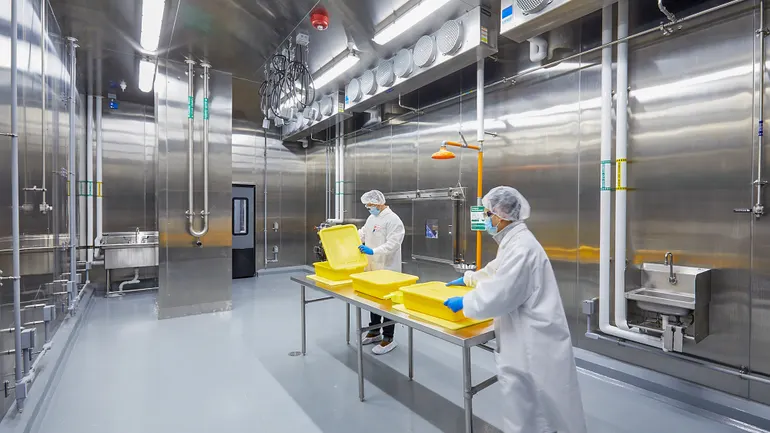
It has been nearly a year since Upside Foods opened its new production facility and innovation center in the San Francisco Bay Area, but the company is already planning further expansion. This 53,000-square-foot Engineering, Production, and Innovation Center (EPIC), located in a former grocery store, is custom-built for the cell-cultured meat company and already meets all conditions required to apply for production and sales permits from the U.S. Department of Agriculture (USDA) and the Food and Drug Administration (FDA). The large silver bioreactor tanks at the center of the facility are clearly visible through the glass windows surrounding the building. Once EPIC is fully operational, it can produce up to 400,000 pounds of cell-cultured meat annually.
This output is enough to supply several restaurants, but it is not yet sufficient to form a true meat supply system for consumers.
In April of this year, Upside Foods completed a$400 million Series C funding round, which will be used for the construction of the company's first commercial-scale facility. Chief Operating Officer Amy Chen stated that the company is selecting a site within the United States and simultaneously carrying out factory design work. She noted that the company has proven it can safely cultivate cells and produce products with a taste that satisfies consumers, and the biggest challenge now lies in achieving scaled production.
"I think the question now is how to leap from thousands of liters to tens of thousands or even hundreds of thousands of liters," Chen said. "The next phase is more of a technical engineering problem than a fundamental scientific challenge."

Standardization details in manufacturing
Designing a viable technology and system in the laboratory is one thing, but manufacturing equipment capable of mass-producing food—especially using entirely new technologies and processes—is quite another.
Cell-cultured seafood company Finless Foods recently moved into its first pilot facility—an 11,000-square-foot space that accommodates larger bioreactors, bigger prototype equipment, more employees, and supports deeper research. Co-founder and CEO Mike Selden said this move has helped the company make tremendous progress.
"In the past, we could only show investors samples and say, 'Hey, this tastes good, what do you think?'" Selden said. "Now we can assemble prototypes we are proud of, and they are very close to products ready for market. This means a lot to us. We have made breakthroughs in entering larger-scale bioreactors and achieving higher cell densities, which both lowers costs and makes it more feasible from a large-scale production perspective."
For Upside Foods, Chen said the company is focusing on scaling up both equipment and raw material supply. Building the supply chain for cell growth media has been one of the company's key focuses in recent months. Growth media essentially provides nutrients to cells, similar to animal feed in the cell-cultured meat field. Upside's media has beenanimal component-freesince last December, and is currently composed of nutrients such as sugars, salts, amino acids, and proteins, but these ingredients may not exist in the volumes Upside needs for scaling, or have never been used in food production before.
Chen revealed that Upside Foods recently hired Sheetal Shah as Senior Vice President of Manufacturing and Operations. Shah previouslyhelped Impossible Foods scale its expansion in retail channels, and before entering the food industry, also helped communications technology companies achieve growth at scale. He is now working with the Upside team to ensure all necessary components, protocols, and partnerships are in place to support the established growth plans.
Treating what was originally a scientific research project as a true food manufacturing enterprise requires a significant shift in mindset. Selden said that before Finless Foods scaled up, he took the industrialization process for granted. Now he realizes there are many factors that must be considered—even including ensuring the standardization of screw sizes and specifications within the factory.
He also had not previously realized how difficult it is for a food company to receive raw materials, turn them into finished products, and bring them to market. Selden pointed out that many cell-cultured meat companies are "vague" about this—seeming to believe that once their products receive FDA market approval, producing the final product will naturally follow.
Finless Foods is also developing a plant-based tuna product, planned to appear on some restaurant menus this fall. Selden said this product is giving him a profound appreciation of the complexity of the entire process.
"I am very grateful we have this plant-based product, because it has shown us how difficult this is and how many processes need to be established to become a real food company," Selden said.

Facing the ultimate test
Although food technology companies are working hard to improve technology, increase facility capacity, raise funds, and accumulate expertise, there is still a critical step in the scaling process: facing consumers directly.
While research shows that consumers are open to technologically produced food, the companies actually producing such food still need to build effective connections with consumers to create products people are willing to buy. Many food startups producing products that consumers already understand and are familiar with ultimately end in failure. Food technology companies must both explain what they are doing and why consumers need to buy it.
Upside Foods' Chen said the company has launched consumer education efforts so that people will look forward to trying the products when they hit the market.
"We spend a lot of time explaining to consumers what cell-cultured meat is, and according to our extensive research, the main obstacle to overcome is lack of information, not other factors, right?" Chen said. "We have found that once consumers start learning about cell-cultured meat, the more they learn, the more excited they become."
Compared to companies launching plant-based alternatives or products that reduce unfavorable nutrients like sodium and sugar, companies using technology to produce next-generation food facegreater difficulty in explaining themselves. Over the years, many companies in the industry have been working to build consumer-centric language and brand narratives.
Eat Just CEO Josh Tetrick said food technology companies need to do a lot of work to improve their products and prepare them for consumers. This work must be ongoing and kept in mind throughout the scaling process.
"At some point, you have to face the ultimate judge—the consumer, and that is a difficult confrontation," Tetrick said. "If your product is not made right, doesn't taste right, or isn't priced right, they don't care how many years you spent, how much of your life you sacrificed, how many properties you mortgaged, or how many relationships you lost—they don't care. They just want to fill their shopping carts and rush home to put their kids to bed."
"...Some companies will pass this test," he continued. "Some companies will never even reach the test. Some companies will reach the test but fail it. And I believe there will be a few companies that pass the test with flying colors and become the leaders that define this entirely new way of producing meat, eggs, and dairy."