
Hain Celestial's New CEO Wendy Davidson's Growth Blueprint: The Transformation Path from Marathon to Health Food Giant
Hain Celestial's new CEO Wendy Davidson is driving growth transformation at this $1.5 billion health food company with a marathon spirit, focusing on three core strategies: innovation, brand awareness, and channel expansion.
In 2016, when Wendy Davidson laced up her shoes for the Chicago Marathon, the challenge for this self-proclaimed non-runner was not about achieving a standout finish time. Davidson's goal was more personal and ambitious: to push her limits and put herself in an uncomfortable state.
Now, she is trying to bring the philosophy and drive from that endurance race into the corporate office—as the new CEO of Hain Celestial. The company holds a leading position in the natural and organic food and beverage space, with revenue of $1.5 billion.
"What I ultimately took away from that race is that you need to take bold steps and put yourself in an extremely uncomfortable state," Davidson said in her first media interview since taking office in January. "For me, at Hain Celestial, the biggest unlock is how to ensure we continuously challenge our way of thinking. How do we do things differently, without allowing the status quo—even if it's successful—to become a place where we get too comfortable?"

Davidson took over the top position from Mark Schiller. Schiller played a key role in stabilizing Hain Celestial. During his four-year tenure, Schiller prioritized streamlining this sprawling food and personal care giant by divesting non-core assets, while curbing sharp sales declines and persistent margin compression.
Davidson's agenda is distinctly different: she was hired to drive growth. "That's how I operate," she said. "I'm the right person at the right time."
Focusing on three core areas
As a seasoned consumer goods veteran, Davidson is no stranger to the food space, having held positions at Kellogg's, McCormick & Company, and Tyson Foods. The 53-year-old executive also has deep insight into the health products Hain Celestial sells, having previously served as president of Glanbia Performance Nutrition Americas, which produces health foods, beverages, and other products, including Think! Bars and SlimFast.
Davidson's agenda to drive growth at Hain Celestial centers on three areas: extracting more value from the existing portfolio through innovation, increasing brand awareness, and accelerating channel distribution. She has wasted no time in driving change to help Hain Celestial achieve the ambitious goals she has set.
To strengthen connections with employees and build trust, Davidson holds weekly "tea chats" with 10 randomly selected employees to learn what's on their minds and what she should focus on. She also organizes monthly all-hands meetings—her first took place just three days after taking office—where employees are encouraged to ask her any questions.
Hain Celestial has also adopted an operating model where employees such as product developers, packaging engineers, marketers, and brand builders can work anywhere in the country—a practice designed to give the company access to the best talent. These people will then converge at a central location for testing, discussion, and troubleshooting. Davidson says this approach will help speed products to market, create products that better meet needs, and improve execution at launch.

Outside the company, Hain Celestial plans to raise public awareness starting in the second half of this year for many of its larger product lines, such as Sensible Portions and Terra chips, several of which have had advertising and promotions halted over the past year.
But a bigger part of getting the company's products more deeply into consumers' minds will come from distributing its healthy foods through broader channels—not just the large supermarkets and health and wellness retail stores where most products are currently sold.
These initiatives include bringing Celestial Seasonings teas into hotel rooms, and bringing its healthy snack brands into settings such as college campuses and school cafeterias.
This strategy is similar to Davidson's approach during her time at Kellogg's, where she spent seven years boosting consumption of the company's brands in settings outside the home, including Pringles, Cheez-Its, Rice Krispies Treats, and Corn Flakes cereal.
Davidson is also looking to deepen Hain Celestial's presence in convenience stores. Convenience store shoppers are often in a hurry, but many of them want to eat healthier. Hain Celestial currently holds less than 1% share in this channel.
"We have a solid portfolio of brands covering a range of large and growing core categories that benefit from tailwinds driven by consumer demand trends," she said. "We need to build from our core business, and I think we have tremendous potential there."
Despite the promising outlook, Kathy Lee, global head of quantitative research at ISS Governance, notes that Hain Celestial still faces declining margins, three consecutive quarters of losses, and a stock price hovering near four-year lows. Sales growth has improved but remains negative.
In its second-quarter earnings report released in February, net sales fell 4.8% year-over-year to $450 million, despite growth in North America, the region contributing nearly two-thirds of the company's overall business.
Lee says that given the strong downward trajectory, this could be a "difficult path, but also one with tremendous opportunity"—provided Davidson can turn Hain Celestial around and create value for the company and shareholders.
"You're taking over a business where obviously everything is moving in the wrong direction," he said. "Market expectations for this company are quite low, so the stock is cheap. The market hasn't priced in significant improvement."
Moving away from the M&A-driven model
For years, Hain Celestial pursued a strategy of brand acquisitions and integration, which caused its portfolio to balloon dramatically. The company's growth-at-all-costs mindset ultimately proved disastrous.
After a period of five years with annual revenue growth exceeding 20%, Hain Celestial suddenly faced slowing sales and narrowing margins. Its stock once came close to being delisted, and activist investors pressured for change.
At one point, more than a third of its nearly 60 brands were losing money, and the company had a sprawling product line spanning 37 different categories.
Today, the company has been significantly streamlined, managing 32 brands globally.
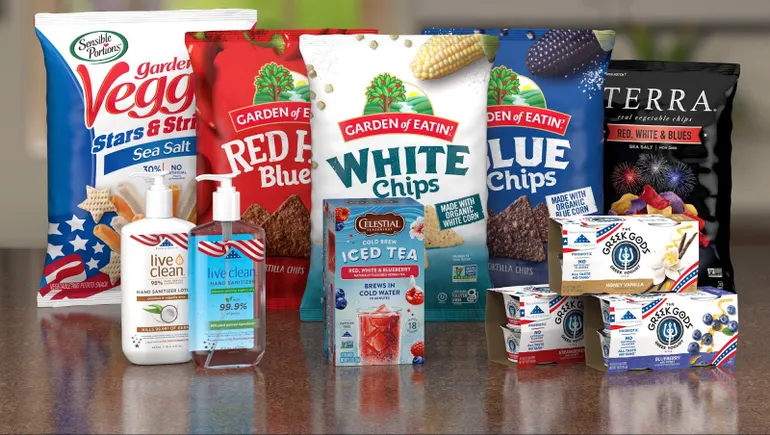
In the U.S. alone, it manages 20 brands, including Celestial Seasonings teas, Sensible Portions Garden Veggie Straws, and Greek Gods yogurt, as well as a personal care portfolio covering facial cleansers, shampoos, sunscreens, and lotions. According to the company, about half of these products rank first or second in their categories.
"For me, at Hain Celestial, the biggest unlock is how to ensure we continuously challenge our way of thinking. How do we do things differently, without allowing the status quo—even if it's successful—to become a place where we get too comfortable?"

Wendy Davidson
CEO of Hain Celestial
After her predecessor spent the past several years divesting brands, Davidson says there is significant growth potential in the existing portfolio without the need for major adjustments.
"I think it's more about fine-tuning the portfolio a bit," she said. "But I don't see the need for large-scale divestitures, nor do I see huge gaps that need to be filled through acquisitions."
Davidson says she is examining brands where Hain Celestial is strong in one region—such as tea and snacks in the U.S., and meat-free products in the UK and Canada—to determine whether they could work in other regions where the company operates. She is also evaluating whether any products could move into adjacent categories with strong consumer demand, such as extending snack brands into energy bars or bringing teas into ready-to-drink hydration products.
Davidson acknowledges that Hain Celestial faces competitors including industry giants such as Hershey, Mondelez International, Campbell Soup, and PepsiCo, all of which have operations in many of the categories where Hain Celestial sells.
These consumer goods giants have also latched onto emerging trends like healthy snacks, launching their own products or upgrading existing ones with attributes such as reduced salt, reduced sugar, or organic claims to make them more appealing.
Despite this, Davidson is not backing down. She says Hain Celestial is in a "sweet spot"—large enough to leverage the marketing muscle and innovation knowledge that competitors possess, while also benefiting from the agility and sharp focus of smaller startups dedicated to specific niches.

Hain Celestial has numerous brands covering various consumption occasions, meeting consumers' natural and organic needs throughout the day—snacks, cooking oils, soups, peanut butter, teas, yogurt, and cookies. Davidson points out that this gives Hain Celestial the scale needed to be credible in expanding customer reach and attracting potential retailers' attention.
The food manufacturer also has more competitively priced products in the premium health food segment, making it more appealing to a broader range of consumers.
Additionally, Hain Celestial focuses exclusively on natural and organic categories. Davidson notes that unlike some large consumer goods competitors, it doesn't have a sprawling portfolio mixed with products that have weaker health credentials, which could dilute focus.
"We're not a big consumer goods company, nor are we a small startup with a single brand. We're in the middle," she said. "So, how do we beat the big guys with our weakness—using agile ways of working to move faster than larger companies? And how do we beat the small guys with our strength—using our scale and capabilities to overperform?"
As Davidson digs deeper into Hain Celestial, she will face many of the same issues other food and beverage companies are grappling with: consumers gradually emerging from the pandemic's shadow, persistently rising inflation, and supply chain disruptions. As conditions improve, Hain Celestial will be better positioned to accelerate its turnaround.
Davidson acknowledges that over the past few years, as these external disruptions pressured the business, the company "hasn't been fully ready to take off the training wheels to drive growth."
"I'm excited about the company's potential because I truly believe we have some very good foundational building blocks," she said. "We have great people, great brands, and a good business, but all of these need investment opportunities."