
General Mills Advances Farmer-Led Regenerative Agriculture Strategy
General Mills released its annual sustainability report, reaffirming that regenerative agriculture is the 'most promising solution' to achieve its 2030 goal of reducing emissions by 30%. The company's Chief Sustainability Officer, Mary Jane Melendez, stated that the strategy does not follow a fixed checklist but rather treats farms as living ecosystems. In 2022, the company added 120,700 acres of regenerative farmland, bringing the total to 235,000 acres. Against the backdrop of a lack of industry-wide unified definitions, the company emphasizes a results-oriented approach and declines third-party certification to avoid 'boxing in' its methods.
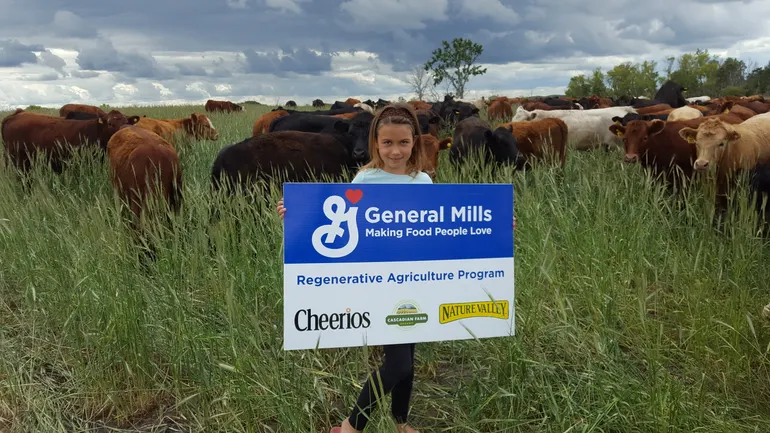
Although the term "regenerative agriculture" has become a core claim for large food companies aiming to reduce their carbon footprint, some critics argue that the term lacks a universally recognized definition, raising questions. General Mills, for its part, says its use of the term is more about listening to farmers who know the land than setting rigid rules.
The cereal and snack giant—which set a goal in 2020 to reduce greenhouse gas emissions by 30% by 2030—released its annual sustainability report this week, in which it called regenerative agriculture "the most promising solution to achieving its climate goals." General Mills defines the term as a farming method that sequesters carbon by capturing atmospheric carbon.
"We're not looking for a checklist," said Mary Jane Melendez, the company's chief sustainability officer. "It's not about intensifying one key ingredient, but about viewing the farm as a living ecosystem and seeking to maximize its potential."
The company says its regenerative agriculture push is driven by outcomes. Melendez, who has worked at General Mills for 17 years and took over environmental affairs in 2019, said the company has been learning from the farmers it sources from.
The maker of Cheerios and Cinnamon Toast Crunch believes its sustainability strategy is paying off.
According to the annual sustainability report, the company added 120,700 acres of regenerative farmland in 2022, bringing its total to 235,000 acres. General Mills also said 92% of its packaging is recyclable or reusable, and 87% of its operations use renewable energy.
Jay Watson, senior manager of the company's global impact program, said the overall strategy for farmers adopting regenerative practices varies by region and the techniques available within the supply chain.
"One of the things we think is beautiful about regenerative agriculture and the broader idea of 'regeneration' is that it's more of a process and a spectrum," Watson said. "So it's hard to put it into a fixed framework."
The annual sustainability report added that General Mills still needs to better integrate farmer and community outcomes because "our initial conceptualization of regenerative agriculture overemphasized ecological outcomes."
Watson said some of the practices farmers are implementing include reducing tillage and fertilizer use, and increasing cover crops.

Stimulating biological interactions between crops
One project under General Mills' regenerative agriculture framework is "intercropping" in Saskatchewan, Canada. The industry group Sustainable Agriculture Research and Education says this practice involves growing two or more crops in close proximity to stimulate biological interactions.
According to Watson, farmers are analyzing multiple plants growing in the same field and observing how these crops perform compared to large-scale monoculture fields.
"It depends on the context, because what works in southern Minnesota may not work in California or northeastern Saskatchewan, but they're all connected by advancing principles," he said.
Some companies implementing regenerative agriculture projects focus on obtaining certification from third-party organizations. Melendez said General Mills is not interested in that because the company doesn't want to be constrained by strategies involving different crops and farming practices.

How food companies can avoid 'greenwashing'
Although many companies claim to be adopting regenerative agriculture practices, some analysts worry that the lack of a clear definition could lead to "greenwashing." A recent report from the agriculture organization Food and Land Use Coalition (FOLU) warned that this could create confusion, misinformation, and skepticism among consumers about what sustainable farming practices can actually achieve.
In a statement to Food Dive, FOLU report author Theodora Ewer said that to mitigate the risk of greenwashing, food companies should set climate goals based on their ability to achieve positive outcomes.
"Food companies should align around an outcomes-based framework and a standardized set of metrics to assess how regenerative agriculture practices lead to positive outcomes in different contexts," Ewer said.
According to General Mills, a key factor in its approach is the ability to quantify improvements in soil biodiversity—including the diversity of bacteria and fungi.
A 2022 study published by the University of Washington found that farms that increased soil biodiversity and added cover crops over five years produced more nutritious food.
"If we're going to talk about regenerative agriculture, we have to measure 'regeneration' itself. Can we prove these methods are context-based and are improving regenerative outcomes? We think that's very important," Watson said.
Melendez said General Mills has learned from the farmers it sources from what methods work best for its supply chain, as many farmers have been using these methods for years. She said this way, the company has been able to translate methods into local contexts.
"We draw experience and insights from farmers who have been practicing these methods longer than we have to develop an open, inclusive definition that allows for context-based approaches," she said.
Cameron Hodgins, who runs a family livestock farm in Canada, began working with General Mills in 2019. Last year, the company invested $2.3 million in its regenerative program to advance its sustainable agriculture efforts in Canada. General Mills said his operation is part of the oats supply it sources. Hodgins told Food Dive that he was already transitioning to regenerative practices before working with the company.
Hodgins added that the most beneficial part of the program has been the network of farmers the company helped him connect with.
"It really opened doors for me to meet practitioners from different commodity groups and build very close relationships," Hodgins said.
"One of the things we think is beautiful about regenerative agriculture and the broader idea of 'regeneration' is that it's more of a process and a spectrum. So it's hard to put it into a fixed framework."

Jay Watson
Senior Manager, Global Impact Program at General Mills
Watson and Melendez said General Mills sees bringing farmers together as a key part of its regenerative agriculture pilot projects, because there is added value in hearing from other practitioners working with the same crops. The company created a private Facebook group for farmers to use.
"It's a safe space for them to connect and share challenges, because this isn't always an easy transition for farmers, especially when you're used to farms with straight rows and very tidy fields," Melendez said.
Hodgins said that if implemented properly, broader regenerative agriculture programs can bring long-term economic benefits to farmers, starting with smaller-scale operations.
"We're seeing a lot of capital coming from small operations on less than an acre," Hodgins said. "So if we can replicate that model across different farms, maybe it opens up space for different generations to participate, and that's where I see a lot of opportunity."
The sustainability of food products is also proving profitable, as consumers increasingly prioritize it when shopping. In a survey by consulting firm Kearney, more than 40% of respondents said they always or almost always consider environmental impact when buying food.
The company believes that through regenerative practices, farmers stand to gain economically. Watson said some of its farmers have already reduced expenses by giving up synthetic fertilizers.
"Instead, they're able to harness the power of nature and drive these ecosystem services in harmony with nature," Watson said.
Correction: An earlier version of this article incorrectly stated that General Mills set its regenerative agriculture goal in 2019. The company set the goal in 2020. An earlier version also misstated the year Cameron Hodgins began working with General Mills, which was 2019, not 2022.